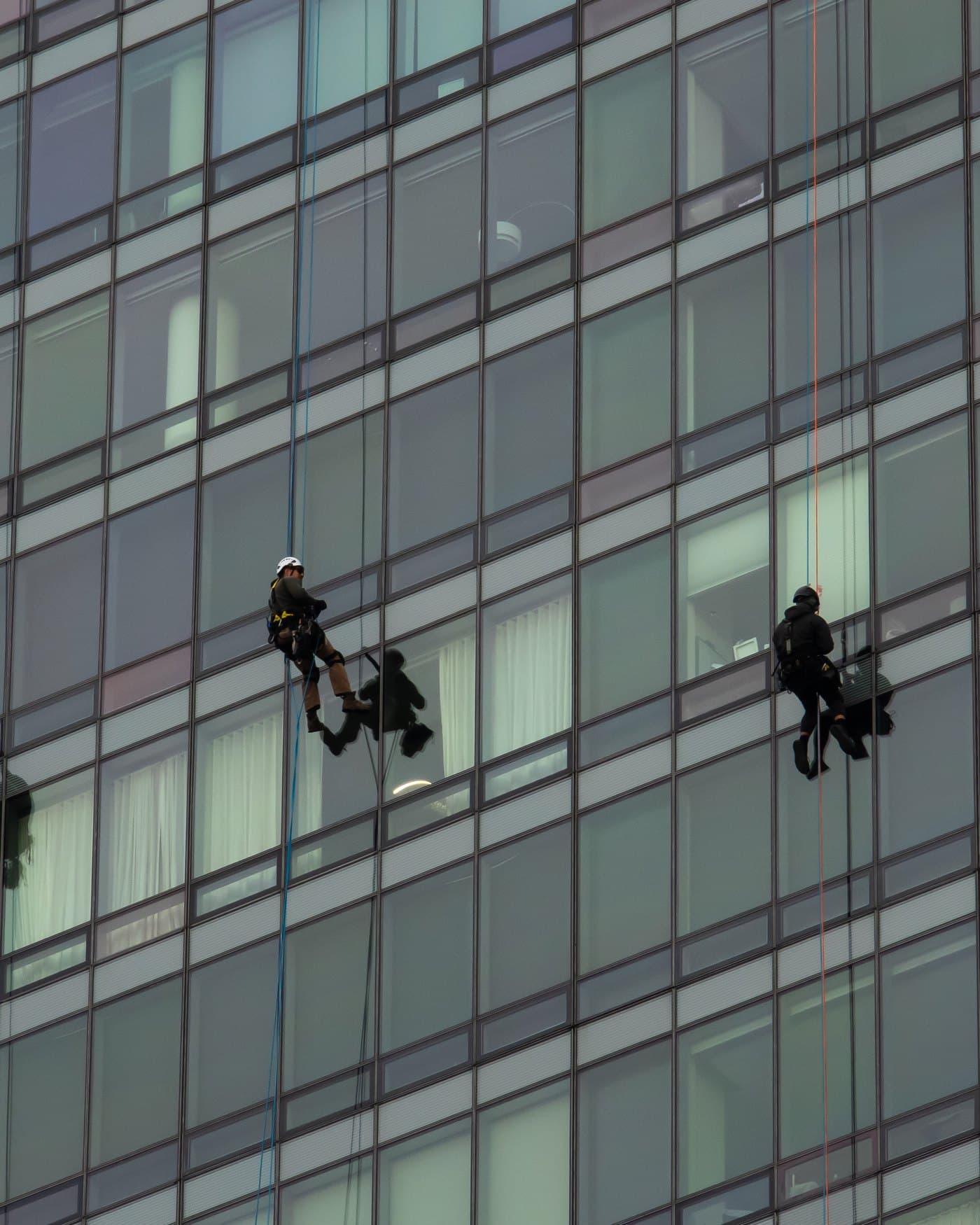
Industrial rope access is often ordered as a standalone service, although it is essentially a way to reach the work area. It does not require space at the foot of the building, does not block access roads and can be set up in hours rather than days. This makes it suitable for sites in densely built-up areas and places with a constant flow of people.
The main constraint is not height but anchor points. Suitable anchoring devices or structures are needed on the roof or parapet, and their condition is checked before work begins. This is often what determines whether rope access is possible on a particular building.
What it can be used for
Cleaning facades, glazing and glass curtain walls
Cleaning roofs, canopies and steel structures
Sealing joints between panels and adjoining surfaces
Installing and removing banners and signs
Installing and servicing equipment at height
Inspecting and photographing the condition of facades in hard-to-reach areas
How the work is organized
Site survey
We check the roof and parapet, the presence and condition of anchor points, hazard areas below, access routes and evacuation routes.
Access plan
We determine how the ropes will be rigged, the anchor points for the working and backup systems, and the route across the facade.
Coordination with the site
We agree on working hours, the boundaries of the work zone and how tenants and responsible site personnel will be notified.
Securing the work zone
The area below the work section is cordoned off and marked for the duration of the work.
Carrying out the work
Work proceeds from top to bottom, section by section, with the barriers moved as the crew moves.
Handover and equipment removal
Handover with the person responsible at the site, removal of the rope setup and cleaning of the area.
What is not included
- Design and installation of permanent anchor linesIf there are no suitable anchor points, this is a separate task requiring a separate contractor.
- Structural assessment and technical inspection of the building
- Major facade repairs and work on load-bearing elements
- Electrical work requiring electrical safety authorization
- Work during high winds, icing or thunderstormsPostponed in accordance with safety requirements.
When rope access is suitable and when it is not
An honest answer to this question can save the client money: rope access is not the cheaper option for every task at height.
Suitable
Localized or dispersed work across a facade, sites in densely built-up areas, sections without vehicle access, tasks where entrances or parking areas cannot be blocked, and short jobs at considerable height.
A truck-mounted lift may be more suitable
Lower levels, canopies and entrance areas where there is room for equipment: setup will take less time.
A lift or scaffolding may be more suitable
Extended work in one area, large quantities of materials, or tasks requiring a stable work platform.
What affects the cost
The cost is determined after a site survey and set out in the contract.
Type and volume of work
Site height and number of storeys
Presence and condition of anchor points
Facade complexity: projections, canopies and ventilated facades
Site operating arrangements and permitted working hours
Need for barriers and approvals
Season and available weather window
Safety and documents
Rope access is regulated work, not a sport. How the work is organized matters more than the equipment.
Qualifications
A valid industrial rope access worker credential and medical clearance are mandatory for the crew we bring to the site. Documents are checked before work begins.
Equipment
Certified equipment is used. The crew is responsible for its completeness and working condition, which are checked before each deployment.
Two independent systems
The working and backup lines are rigged to separate anchor points.
Responsibility
Our contractual liability to the client is insured. The contracted crew provides occupational safety arrangements and worker authorizations, which we check before the crew goes to the site.
Site documents
We provide the crew list, credentials and confirmation of the safety briefing. Before work begins, we agree on the work zone with the person responsible at the site.
Frequently asked questions
What do you need us to provide at the site?
Roof access, a contact person to agree on the work zone and schedule, and the ability to cordon off the area below. If anchor points are available, that is sufficient. We check everything else during the site survey.
What if there are no anchor points on the roof?
This is the most common question. During the survey, we check whether there are suitable structures that can be used for rigging in accordance with the applicable rules. If there is nothing suitable, we will say so: either an anchor line will need to be installed as a separate task, or another access method will be needed.
Which costs less: industrial rope access or a truck-mounted lift?
It depends on the task. On lower levels with vehicle access, a truck-mounted lift is usually the better option. At height, in densely built-up areas and where a road cannot be blocked, rope access costs less and is quicker to set up. During the survey, we will advise which is more suitable for your site.
At what heights do you work?
The practical limit is set not by height but by the availability of suitable anchor points. This is checked during the survey.
How quickly can you visit?
For urgent requests, we aim to visit within a day. We confirm the time when you contact us; it depends on site access, the approvals needed and weather conditions.
How large is the crew that attends the site?
A crew of 4–8 people attends the site. The crew size depends on the volume of work and the requirements for organizing the work zone: some crew members are always assigned to safety duties below.
Other services in this area
Facade cleaning
We clean glass, composite and mixed facades of commercial buildings. We work without closing the site, during agreed hours, on night shifts or at weekends. Site visits are free.
Learn moreHigh rise window cleaning
We clean glazing at height: panoramic windows, large glazed panels, glazed roofs and atriums. We work on both the exterior and interior, floor by floor, without stopping tenants' operations.
Learn moreCleaning hard-to-reach structures
Entrance canopies, overhead structures, metalwork, signs, atrium roofs and advertising elements: areas reached by neither premises cleaning nor standard facade washing.
Learn more